
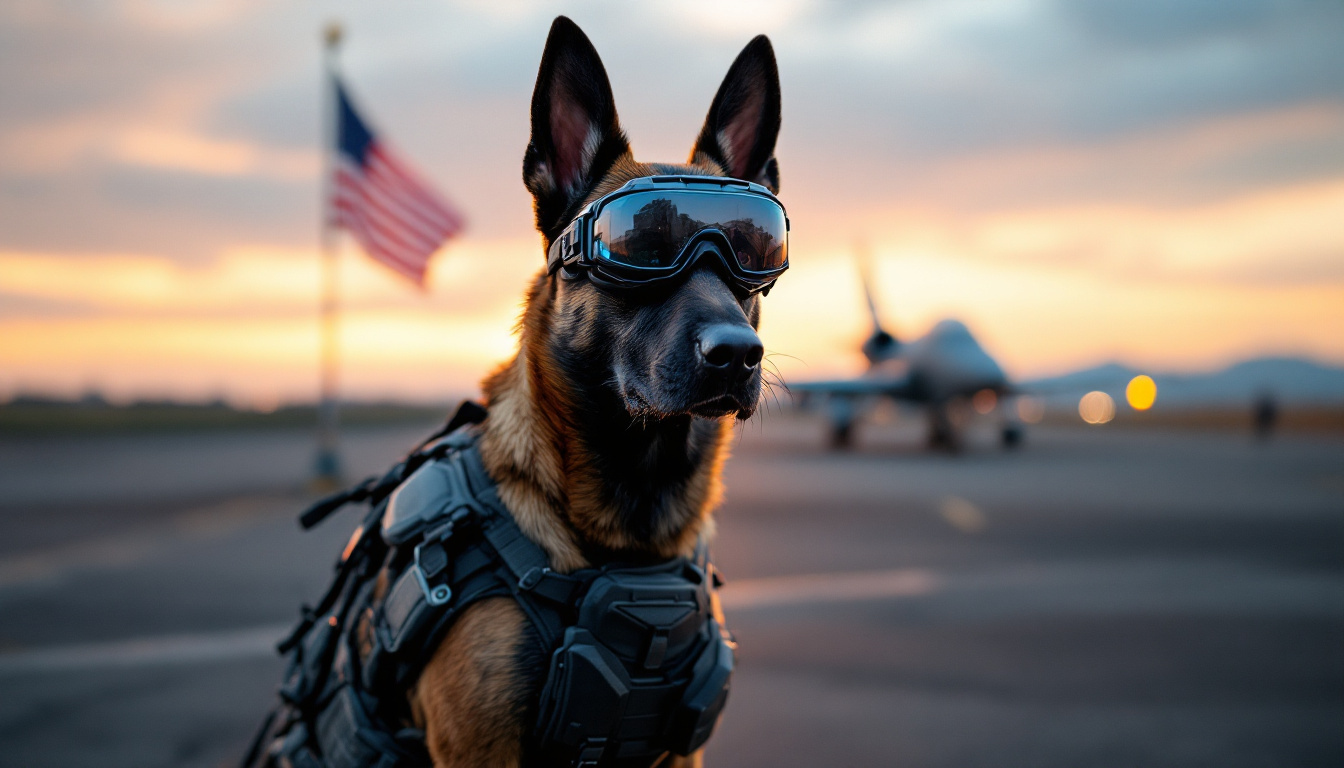
Three cloned puppies named Romulus, Remus, and Khaleesi have already had 20 gene sites edited across 14 genes. They are Belgian Malinois. They will be wearing augmented-reality goggles and body armor made by the same defense company that builds autonomous fighter jets. And they will be sniffing out bombs for the United States military.
The company is called Warhound, and it just raised $200 million before producing a single operational dog.
Warhound emerged as a joint venture between Palmer Luckey, founder of Anduril Industries, the defense-tech firm behind everything from autonomous drones to AI-powered surveillance towers, and Ben Lamm, co-founder and CEO of Colossal Biosciences, the Dallas-based company whose previous headline-grabbing promise was bringing back the woolly mammoth. Their new promise is more immediate: gene-edited, cloned military working dogs equipped with Anduril's cybernetic gear, delivered to the Pentagon on a subscription model they're calling "Canine-as-a-Service."
Running the operation is David Spirk, a former Marine who served as the Pentagon's chief data officer. The $200 million seed round — valuing Warhound at $1.2 billion before a single dog has deployed — was led by Sequoia Capital with participation from ARK Invest, Franklin Templeton, Breyer Capital, 8VC, and In-Q-Tel, the venture firm backed by the CIA and U.S. intelligence agencies.
The problem Warhound is solving is one the Pentagon has quietly failed to fix for decades. The U.S. military maintains over 2,200 working dog teams across all branches. More than 80 percent of those dogs are sourced from Europe. The military has to buy roughly 200 dogs to field 100 — because fewer than half of the imported animals pass training. American breeders contribute about 13 percent of the total, mostly from Texas. The rest come from overseas kennels where the U.S. government is bidding against foreign militaries for the same limited supply of animals.
"A dog is the oldest autonomous system there is," Lamm told Fortune. "For thousands of years, dogs have gone into danger ahead of the people they protect."
What Warhound proposes to do is biobank genetic material from the highest-performing military, police, and first-responder dogs in the country — mostly Belgian Malinois, some Labrador Retrievers, some German Shepherds — clone proven performers, and conduct targeted gene edits to screen out the inherited conditions that end careers early. Hip dysplasia. Cancer predisposition. Poor eyesight. Muscle degeneration. As Lamm put it: "No dog enters service carrying genetic markers known to cause common career-ending conditions."
Then comes Anduril's contribution. Each dog gets fitted with eye and ear protection, body armor, and the company's Eagle Eye headgear system — augmented-reality technology that gives the handler real-time situational awareness of what the dog is seeing and hearing in the field. "Man's best friend deserves man's best tech," Luckey said, which sounds like a bumper sticker until you realize the man saying it builds weapons systems for the Department of Defense.
The first batch of cloned dogs is expected to be born in early 2027, with operational deployment roughly two years out. The dogs will be socialized for months before formal training begins at one year of age.
What makes this story worth paying attention to isn't the science-fiction headline. It's the supply chain. America's military has been dependent on European dog breeders the same way it was dependent on Chinese rare-earth minerals — quietly, embarrassingly, and with no serious plan to fix it until someone outside the Pentagon decided to act. Luckey and Lamm didn't wait for a congressional subcommittee. They raised a billion-dollar company, hired a former Marine to run it, got the CIA's venture arm to invest, and started editing genes.
"No machine today matches a dog's nose or its judgment in complex environments," Lamm said.
The Pentagon spends billions on autonomous systems that can't do what a Belgian Malinois does on instinct. Warhound's bet is that the answer isn't replacing the dog. It's building a better one — and making sure it's born in Dallas, not Düsseldorf.