

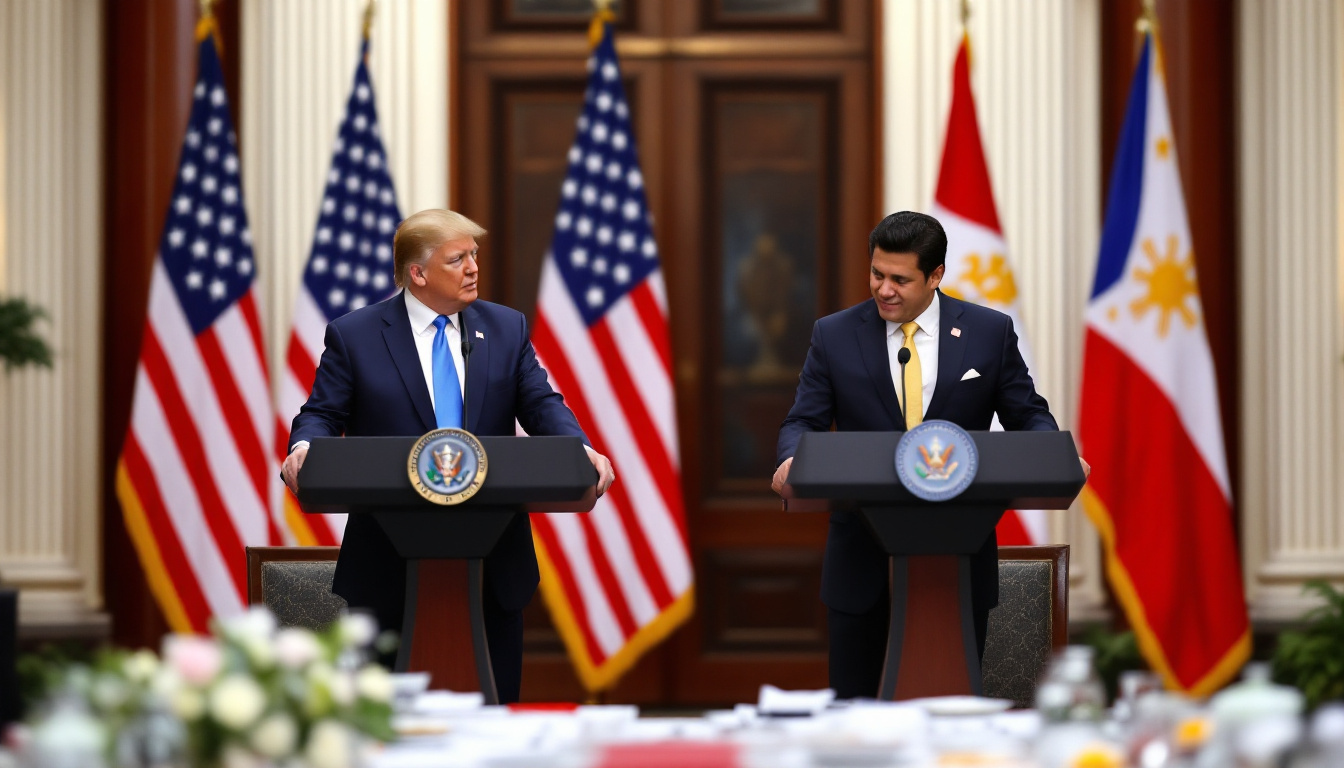
President Trump stood inside Malacañang Palace on Wednesday, Philippine President Ferdinand Marcos Jr. beside him at a state luncheon, and announced that the United States had just closed what he called the biggest bilateral trade deal in American history. He'd been in Asia for roughly 36 hours. He already had Thailand in the bag from the day before.
"We've just consummated a very big trade deal, the biggest trade deal we've ever made by far," Trump said. "And it's a fair deal for both countries."
The Philippines deal, according to Trump, covers agriculture and energy — the two sectors where American producers have been getting squeezed out of Southeast Asian markets for decades. "I am pleased to announce that we made a new and completely different Trade Deal with the Philippines," Trump wrote on Truth Social after departing Manila, "one that will be a true landmark and, in particular, a Deal that will be great for our Farmers and those in the business of 'Energy.'"
Philippine Ambassador Jose Manuel Romualdez confirmed the scope: "The US offered for us to diversify our food supply and energy requirements." Trump added during the luncheon that the whole thing came together fast. "We didn't know it was going to take place, but it took place very quickly. And it's a magnificent deal for both."
That was deal number two. Deal number one landed Tuesday, when Trump and Thai Prime Minister Anutin Charnvirakul signed a joint statement declaring negotiations had reached a substantial conclusion. Thailand agreed to eliminate all tariffs on U.S. exports — automobiles, medical devices, pharmaceuticals, ethanol, and poultry — plus purchase $2.6 billion in additional American agricultural products. "Thailand will eliminate all tariffs on U.S. exports," Trump said at the signing ceremony, "which is something that we've been after for a long time."
So the scorecard after 48 hours on the ground: Thailand locked in with $2.6 billion in farm purchases and zero tariffs on American goods. The Philippines locked in on agriculture and energy. And sandwiched between the two deals, Trump held the first Quad Leaders' Summit in two years — sitting down with Australian Prime Minister Anthony Albanese, Indian Prime Minister Narendra Modi, and Japanese Prime Minister Sanae Takaichi to coordinate Indo-Pacific strategy.
This is what a foreign trip looks like when the person taking it actually wants something specific and knows how to get it. The 49th ASEAN Summit in Manila was supposed to be the main event. Trump turned it into a pit stop between bilateral wins.
The media will spend the next 72 hours noting that the Philippine deal lacks published terms and that Ambassador Romualdez told reporters nothing was formally signed yet. That's how trade frameworks work. The Thailand deal went through the same preliminary-to-final sequence in October 2025 before reaching its current stage. The fact that the Philippine side confirmed the scope — food supply and energy diversification — while the framework was still warm tells you more about the momentum than any missing signature does.
Meanwhile, Trump headed from Manila to Shenzhen for the APEC Leaders' Meeting, where Chinese President Xi Jinping and Russian President Vladimir Putin are both waiting. The trilateral meeting everyone's been watching for. And he's walking in with two fresh trade agreements in his back pocket and a Quad alliance he just reassembled after a two-year gap.
The NY Post reported the Philippines announcement as the latest in a string of economic wins on the Asia trip. That framing undersells it. This isn't a string. It's a sequence — each deal building leverage for the next conversation.
American farmers got $2.6 billion in new Thai purchases on Tuesday. American energy producers got a Philippine market opening on Wednesday. On Thursday, Trump sits across from Xi.
The table's been set.