

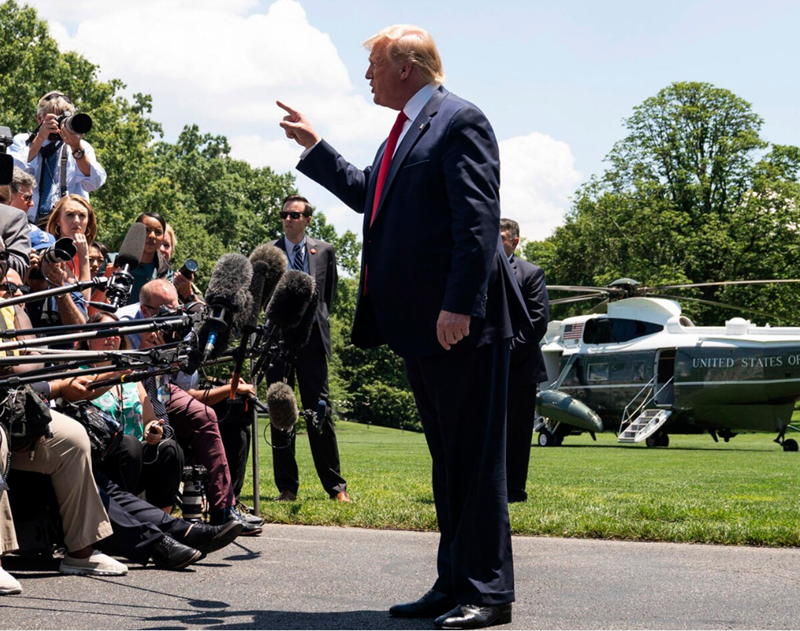
President Trump stood at Bedminster on Saturday and said something no diplomat would ever say out loud: "I think we're going to maybe get something, but I want to give them every last chance before decapitation."
Iran's response was to deny that negotiations exist.
Iranian Foreign Ministry Spokesman Esmail Baghaei told reporters, "We currently do not have negotiations with America." Which is a fascinating thing to announce while your government is reportedly in the final stages of exchanging maps with Oman over a new Hormuz transit route — a deal that only matters because the United States wants it to happen.
Trump wasn't subtle about the stakes. "This is their last chance to sign a good document," he said, adding that "there is a deal on Hormuz, and it will be a deal on the nuclear." He linked the shipping lane agreement directly to the broader nuclear question, which is exactly the kind of package deal that makes State Department careerists break out in hives.
The markets believed him. Brent crude dropped 4.5% to just above $83 per barrel. Stocks surged. When oil prices fall on a threat of military action, it means traders think the threat is actually going to produce a deal — not a war.
Polymarket still has the odds of a U.S. invasion of Iran before 2027 at just 21% yes versus 80% no. The betting markets are pricing in exactly what Trump is selling: credible force as leverage, not as policy.
The backdrop includes CENTCOM having prepared a two-week bombing campaign option — a detail that gives "decapitation" a very specific operational meaning. U.S. Envoy Steve Witkoff and Jared Kushner have been working the diplomatic channels, with Crown Prince Mohammed bin Salman and Gulf allies reportedly involved in halting a planned strike in favor of giving diplomacy one more window.
Trump referenced that directly. "We had an attack that would have been the biggest attack since WORLD WAR II," he said. "When the allies asked to call it off, you gotta say, Well, let's see."
So the sequence is: America builds a strike package large enough to compare to World War II, Gulf allies ask for a pause, Trump agrees to let diplomacy play out, and Iran responds by claiming nobody's even talking. Meanwhile, Oman and Iran have been exchanging maps for seven to eight days on the Hormuz route, and vessel traffic through the Bab al-Mandeb strait dropped from 27 ships on Saturday to 18 on Sunday.
Iranian Foreign Minister Abbas Araghchi is threading a needle that doesn't exist. You can't simultaneously deny negotiations with the United States and negotiate a shipping deal that only has value because the United States is the one applying pressure. The "we're talking to Oman, not America" framing is the diplomatic equivalent of telling your wife you're not at the bar — you're at the restaurant that happens to be inside the bar.
The previous administration's approach to Iran involved John Kerry, a pallet of cash, and a deal that let Tehran enrich uranium on a timeline. Trump's approach involves the word "decapitation" on live television and a CENTCOM strike plan sitting in a drawer.
One of those approaches moved oil prices. The other one moved pallets.