

Imagine opening your pay stub and seeing federal income tax… gone.
Not reduced.
Not tweaked.
Gone.
That’s the turning point President Trump just put on the table — a proposal so sweeping it would fundamentally rewrite how the federal government funds itself. And if Congress doesn’t water it down, stall it, or sabotage it, the financial implications for hundreds of millions of Americans would be enormous.
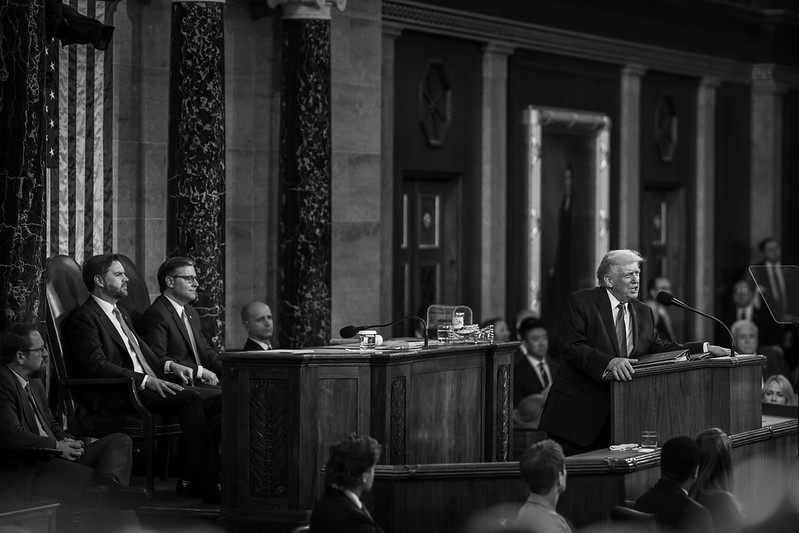
During Tuesday’s State of the Union, Trump declared that tariff revenue from foreign nations could eventually replace the federal income tax system entirely.
That’s not a minor policy adjustment.
That’s a return to how America operated before 1913.
Before the ratification of the Sixteenth Amendment, the United States funded itself primarily through tariffs and excise taxes. Trump is proposing nothing less than a revival of that constitutional framework — shifting the burden away from American workers and toward foreign producers seeking access to U.S. markets.
“Countries that were ripping us off for decades are now paying us hundreds of billions of dollars,” Trump declared. “They were ripping us off so badly, you all know that, everybody knows it, Democrats know it, they just don’t want to say it.”
The core idea is straightforward. If foreign nations and corporations pay substantial tariffs to access the American consumer base, that revenue could theoretically offset — or even eliminate — the need for income taxation on American citizens.
To understand the scale of the challenge, consider this: income tax receipts totaled approximately $2.2 trillion in fiscal year 2023. Any serious effort to replace the system would require tariff revenues approaching that level.
That’s ambitious. But it’s not theoretical.
Trump acknowledged the Supreme Court’s recent decision striking down his emergency tariffs, calling it “very unfortunate.” Still, he made clear he believes leverage remains firmly in American hands.
“The good news is that almost all countries and corporations want to keep the deal that they already made, knowing that the legal power that I, as President, have to make a new deal could be far worse for them,” Trump explained.
This is more than revenue policy. It’s negotiating strategy.
Trump even tied tariffs to foreign policy wins: “Many of the wars I settled was because of the threat of tariffs. I wouldn’t have been able to settle them without.”
The economic mechanics are simple, even if the politics are not. Tariffs operate as consumption taxes paid by importers, typically passed along through pricing. Income taxes, by contrast, directly reduce take-home pay.
For many conservatives, the distinction matters. One targets foreign producers entering U.S. markets. The other targets the earnings of American workers.
Critics argue tariffs function as hidden taxes and risk trade wars. That concern isn’t imaginary. But the current system already burdens American income while foreign competitors operate under advantageous terms. Trump’s proposal seeks to rebalance that equation.
“As time goes by, I believe the tariffs paid for by foreign countries will, like in the past, substantially replace the modern-day system of income tax, taking a great financial burden off the people that I love,” Trump declared.
That line wasn’t rhetorical flourish. It was a shot across the bow of a century-old tax regime.
Now comes the real test.
Can Congress handle something this big? Or will entrenched interests, lobbyists, and institutional inertia choke it off before it ever reaches American paychecks?
If this vision becomes reality, it wouldn’t just tweak the tax code. It would represent one of the most dramatic financial shifts in modern American history.
The turning point is here.
Whether it becomes a revolution — or another missed opportunity — now depends on Capitol Hill.