
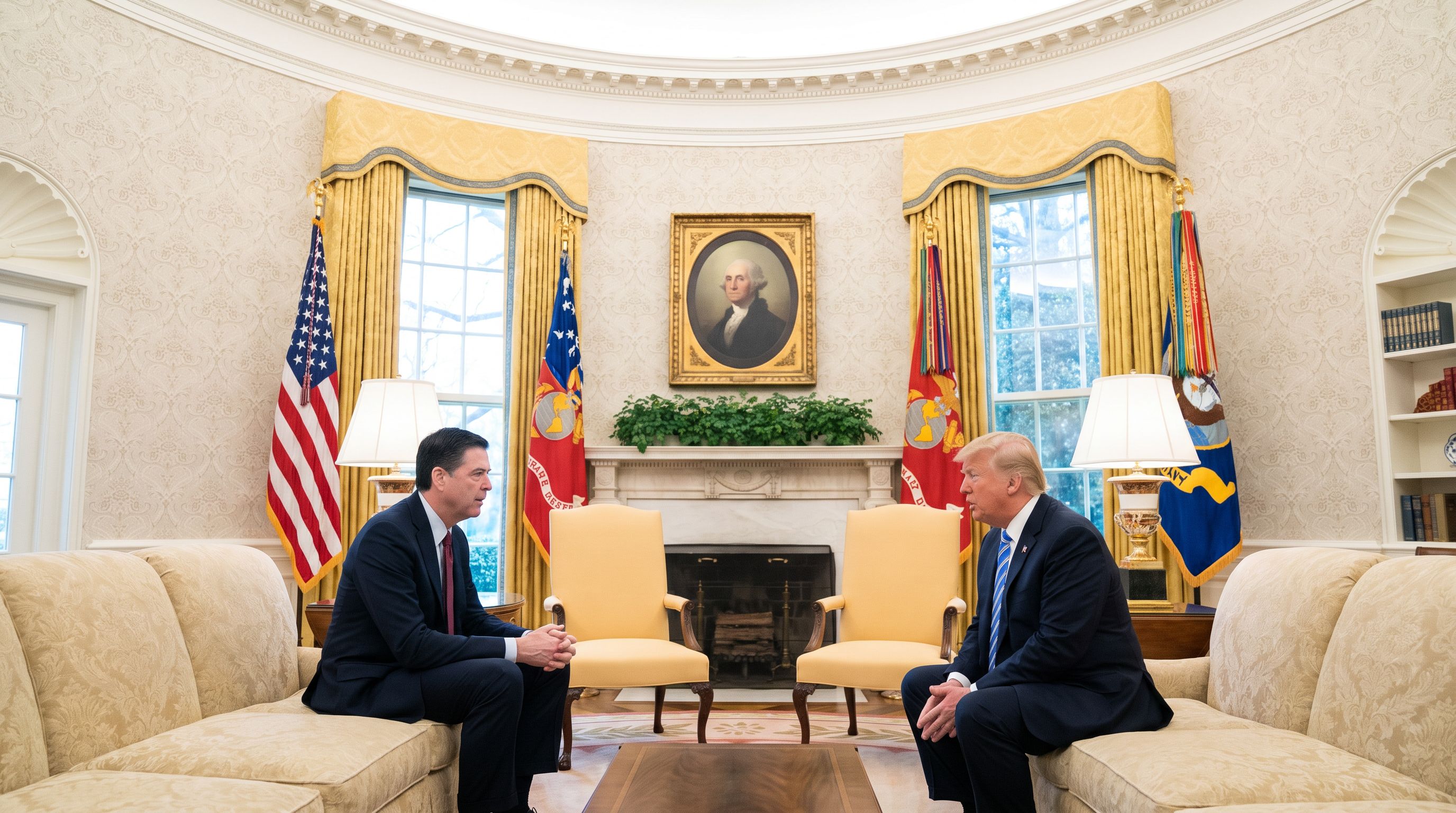
Seven days after Donald Trump fired FBI Director James Comey on May 9, 2017, the Bureau quietly opened a full counterintelligence investigation into the sitting President of the United States. The case name was "Oxferd Comma." The goal, according to the FBI's own opening memo dated May 16, 2017, was to determine whether Trump was "directed by, controlled by, and/or coordinated activities with, the Russian Federation."
The recently declassified FBI files paint a picture of an agency that launched one of the most extraordinary investigations in American history — targeting its own Commander-in-Chief — while its some of its own agents privately acknowledged the evidence wasn't there.
Three days after "Oxferd Comma" opened, FBI Deputy Assistant Director Pete Strzok texted FBI Special Counsel Lisa Page on May 19, 2017. His words: "I hesitate in part because of my gut sense and concern there's no big there there." This is the same Pete Strzok who helped launch the original Crossfire Hurricane probe into the Trump campaign. Even he wasn't buying it.
The investigation ran for nearly two years before closing on April 9, 2019. Robert Mueller's special counsel investigation, which ran parallel, found no collusion between the Trump campaign and Russia. Durham's investigation, completed in 2023 under the Biden DOJ, concluded no basis existed for opening the original Crossfire Hurricane investigation in the first place.
But the internal details are where this gets ugly.
Special Agent William Barnett, interviewed in 2020, said he "still did not see any evidence of collusion between the TRUMP Campaign and the Russian Government." Barnett revealed that agents had turned the whole thing into a running joke. They created a hypothetical game they called "Collusion Clue" — where "investigators are able to choose any character conducting any activity, in any location, and pair this individual with another character and interpret it as evidence of collusion."
The agents investigating the president for being a Russian asset were literally making board games out of how absurd the theory was.
Then there's the Christopher Steele dossier — the document the FBI used to obtain surveillance warrants on Trump campaign aide Carter Page. The dossier was funded by Hillary Clinton's campaign law firm. Its primary subsource, Igor Danchenko, was later suspected of being a Russian asset himself. By early 2017, the FBI had evaluated the dossier and found it mostly uncorroborated. Steele's own subsources distanced themselves from the claims attributed to them.
And on the Mike Flynn front, FBI Assistant Director for Counterintelligence William Priestap wrote a note before agents interviewed the incoming National Security Adviser that should chill anyone who believes in due process: "What's our goal? Truth/Admission or to get him to lie, so we can prosecute him or get him fired?" The FBI had already closed its investigation of Flynn on January 4, 2017, after finding "no derogatory information." They reopened it anyway.
The timeline underneath all of this matters. On July 26, 2016, CIA Director John Brennan's notes referenced intelligence summarizing an "alleged approved by Hillary Clinton" proposal "to vilify Donald Trump by stirring up a scandal claiming interference by the Russian security service." By August 3, 2016, Brennan had briefed President Barack Obama, Vice President Joe Biden, DNI James Clapper, and FBI Director Comey at the White House on both Russian interference efforts and the Clinton campaign's plan.
So the FBI knew — before it opened Crossfire Hurricane, before it applied for the Carter Page warrants, before it launched "Oxferd Comma" — that the Russia-collusion narrative had roots in a Clinton campaign opposition research operation. They proceeded anyway.
The standard defense from FBI leadership has been that agents were duty-bound to investigate any potential national security threat, regardless of political considerations. Which would be more persuasive if the agents doing the investigating weren't texting each other about how there was "no big there there," inventing satirical board games about the evidence, and writing memos about whether the goal was truth or entrapment.
A federal prosecutor in Fort Pierce, Florida is currently investigating aspects of these matters. Durham's 2023 report laid out the institutional failures. The documents compiled trace the mechanics — how an investigation with no evidentiary foundation survived for two years across multiple FBI leadership changes, from James Comey to Acting Director Andrew McCabe, with Deputy Attorney General Rod Rosenstein and FBI General Counsel James Baker all playing roles in the chain.