

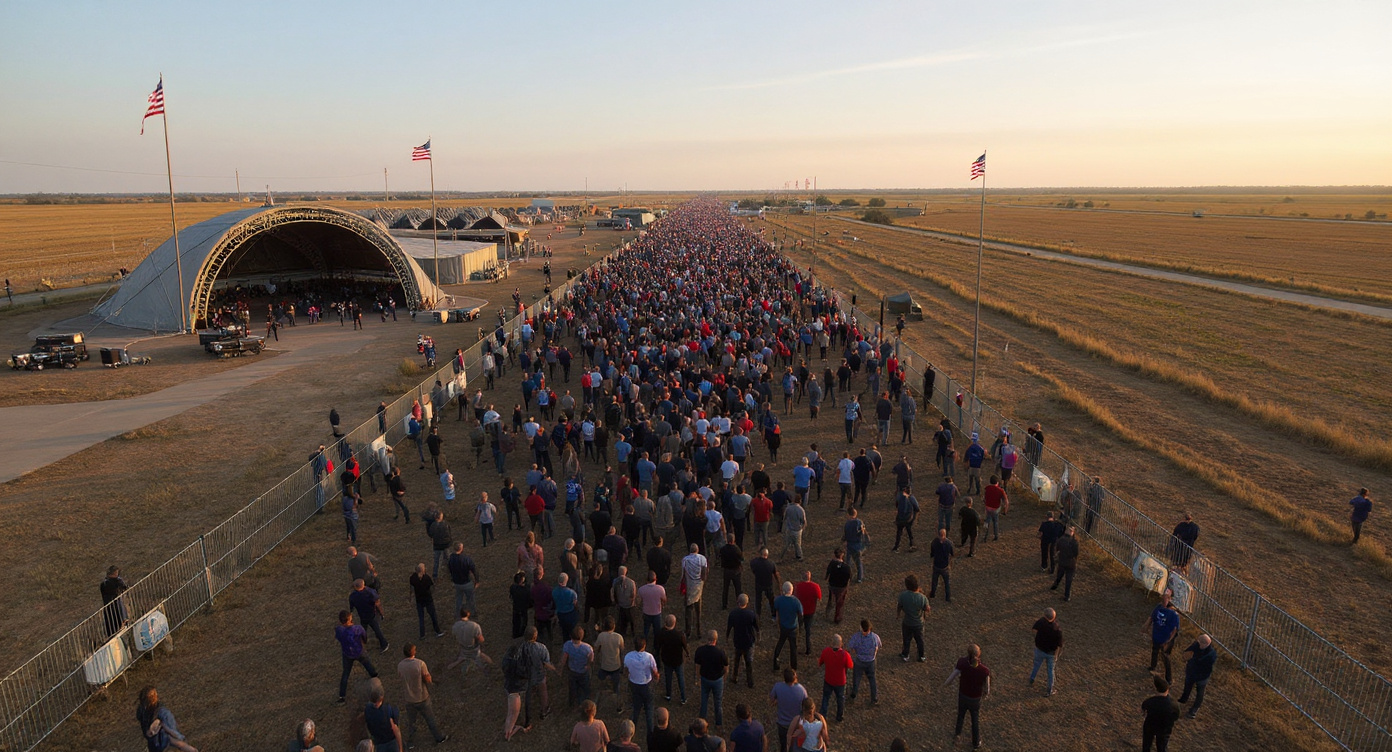
The line to get into President Trump's rally in Grand Island, Nebraska stretched so far this weekend that people who arrived early still couldn't see the entrance. Rally organizers called it one of the longest Trump rally lines seen in years. Grand Island isn't Manhattan. It isn't Miami. It's a city of about 53,000 people in central Nebraska, and it filled up like a stadium parking lot on game day.
Emerson College says Democrats lead Republicans 53% to 42% on the congressional generic ballot. The polls are wrong yet again.
That's an 11-point gap, based on a survey of 1,000 likely voters conducted in September with a credibility interval of plus or minus 3 points. The same Emerson poll found that 71% of likely voters were "very excited" to vote and another 20% were "somewhat excited." So the enthusiasm is real across the board — both sides are fired up. The question is whether the enthusiasm is landing where the pollsters think it's landing.
Because what happened in Grand Island isn't happening in isolation. Trump has drawn similar overflow crowds in Oklahoma and Ohio in recent weeks. These aren't coastal media markets where a presidential visit is a Tuesday. These are deep-red and swing-state stops where people drive hours, stand in lines that wrap around city blocks, and treat a rally like a political pilgrimage. That level of organizational commitment doesn't show up in a phone survey.
The generic ballot has always been a blunt instrument. It asks voters which party they prefer for Congress without naming a single candidate, a single district, a single local issue. It's useful for capturing national mood. It is terrible at capturing what actually happens when a specific Republican is running against a specific Democrat in a specific House seat where Trump held a rally two weeks before Election Day.
And the gap between generic ballot polling and actual midterm results has a history. In 2022, generic ballot polls showed Democrats with consistent leads heading into November. Republicans won the House anyway. The polls weren't wrong about national sentiment — they were wrong about where the votes were concentrated. A ten-point Democratic advantage in Manhattan doesn't flip a single competitive district in Nebraska's 2nd.
The Emerson numbers are real numbers from a credible outfit. Nobody's saying the poll was cooked. What we're saying is that a survey of 1,000 people nationally, conducted in September, is being treated as a forecast for races that will be decided by turnout in specific precincts in early November. That's not analysis. That's a narrative looking for a number to lean on.
Meanwhile, the thing that actually predicts turnout — the physical, observable, countable act of people showing up — keeps pointing in the same direction it pointed in 2016 and 2020. Rally size isn't a perfect proxy for electoral performance. But when the polls say the energy is elsewhere and the rallies say it's right here, one of those indicators requires people to leave their house and stand in line for six hours.
The other one requires answering a phone call.