

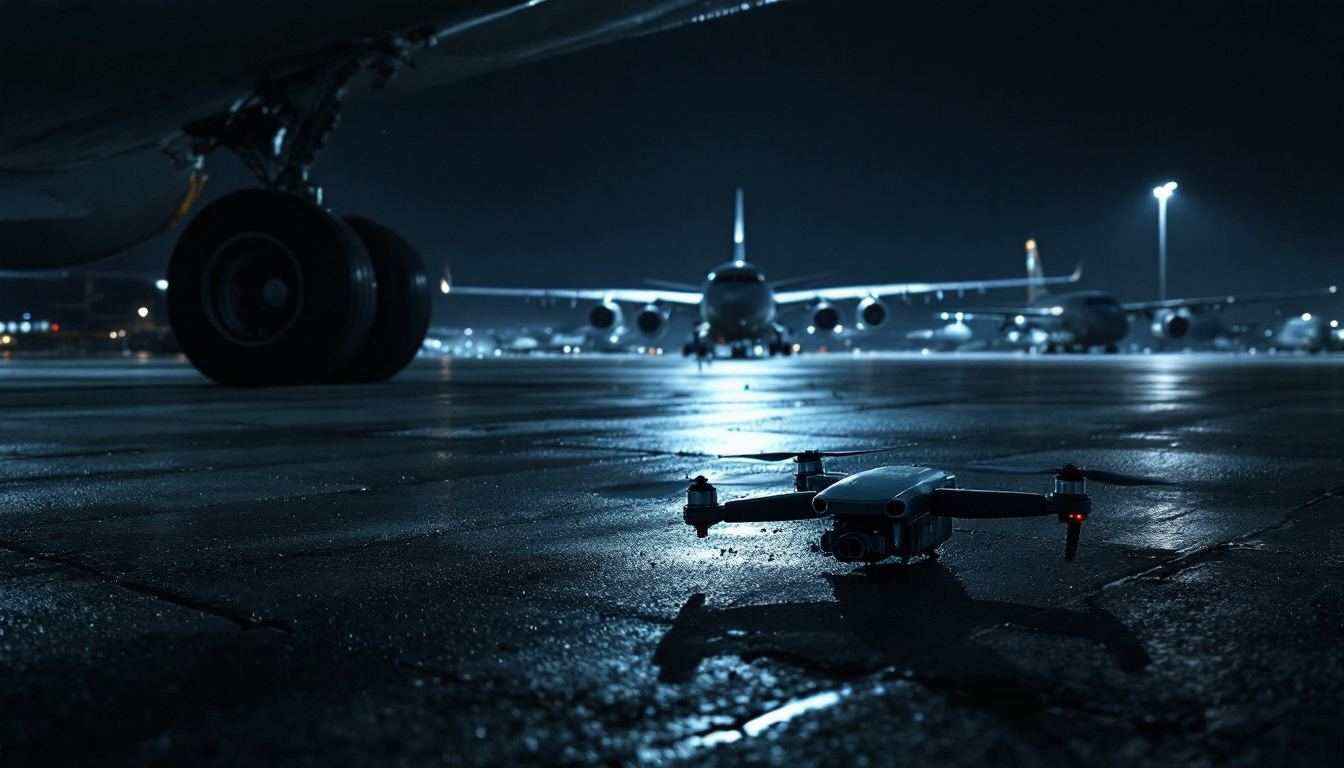
Russia has spent the last three years perfecting a new instrument of terror on Ukrainian soil: the FPV drone. Cheap, commercially available, and repurposed into precision killing machines, these devices have been hunting Ukrainian civilians in streets, markets, and open fields — chasing them down, following them into buildings, waiting them out.
On August 4th, a Russian drone pursued a 52-year-old vegetable seller through a farmers' market in Kherson. Footage of the hunt spread globally within hours. Ukrainian President Zelenskyy called it "drone safari." It wasn't an isolated incident. Ukraine's prosecutors recorded 7,787 FPV drone attacks on civilians in 2025 alone — a number that had been 187 just three years earlier. The UN verified 418 civilian deaths and 2,437 injuries from short-range drones in the first six months of 2026. Russia was launching 1,200 to 1,400 of them every day.
Later that same evening, a different Russian drone crossed into Germany.
At 7:30 pm on August 4, a drone packed with Semtex and PETN military-grade explosives flew past every air defense system at Germany's Leipzig/Halle Airport, slammed into the wing of a Ukrainian Antonov cargo plane, bounced off, and landed on the tarmac. The detonator malfunctioned. A bomb-defusing robot removed it four hours later.
A bus driver found it first.
Leipzig/Halle isn't some regional airstrip. It's the primary operational base for NATO's Strategic Airlift International Solution — SALIS — the program that uses Ukrainian Antonov An-124 cargo planes to move military equipment reinforcing NATO's eastern flank. Since Russia invaded Ukraine, Leipzig has become one of Antonov Airlines' most important bases outside Ukrainian territory. Which makes it one of Moscow's highest-value targets on NATO soil.
U.S. intelligence agencies confirmed the drone was Russian. DNA traces recovered from the device connected it to a firebomb mailed to the same airport in July 2024 — part of a broader GRU sabotage campaign targeting European logistics infrastructure. Four parcels shipped from Lithuania to the UK and Poland, hidden inside vibrating massage pillows triggered by electronic timers. One detonated at a DHL depot near Birmingham. Another exploded inside a DPD truck crossing Poland. A third caught fire at Leipzig — the same airport — before being loaded onto an aircraft. Lithuanian prosecutors identified 22 suspects working on behalf of Russia's GRU military intelligence service. A Ukrainian citizen tied to the plot dug up a buried cache from a Lithuanian cemetery: drone parts and cans of corn filled with explosives, left there by Russian operatives.
Cans of corn. Filled with explosives. Buried in a cemetery by Russian spies. That's where we are.
Package bombs in 2024. An explosive drone in 2026. Same airport. Same Russian fingerprints. The campaign didn't stop — it evolved.
German Interior Minister Alexander Dobrindt called it a "professional, hybrid threat scenario." He noted it "does not point to an amateurish approach" and acknowledged that foreign powers "quite obviously want to contribute to considerable uncertainty in Germany." U.S. intelligence has separately warned Poland of Russian plans to strike critical infrastructure with drones and missiles — a signal that Leipzig is a data point in a pattern, not an isolated incident.
The security failure here is the one nobody wants to say out loud. A device costing a few hundred dollars flew undetected past every radar system, every perimeter sensor, and every security protocol at one of NATO's most sensitive military logistics hubs. It struck a plane, sat on the tarmac for four hours, and was found by a bus driver making his rounds.
Every security system failed. The bus driver succeeded.
That's Moscow's calculation. These attacks are calibrated to stay just below the threshold of a formal NATO response — close enough to threaten, small enough to answer with press conferences instead of consequences. Each one a test. Each one a proof of concept for the next.
The same drone technology Russia has been using to hunt civilians through Ukrainian markets showed up at a German airport on the same day. The technology is the same. The targets are different. And the detonator that failed this time won't fail forever.