
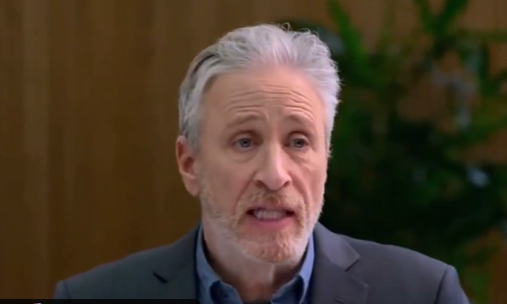
Jon Stewart sat in front of a camera this week and told his audience that what makes America special is that "we have a Media that tells the truth." He said it with a straight face. He said it in 2026.
He then warned that "a media machine that purposefully lies to its people to maintain a political fiction" is the hallmark of authoritarianism. He was talking about the other guys.
This is the same Jon Stewart who spent years on Comedy Central building a media ecosystem that treated half the country as a punchline. The same Stewart whose entire brand depends on the audience trusting that his version of events is the real one — while every other version is propaganda. He retired, came back, retired again, came back again, and each time the schtick is the same: I'm the only honest guy in the room.
So when he warns about a media machine that "purposefully lies to its people to maintain a political fiction," the question isn't whether he's right. The question is whether he owns a mirror.
The American media — the one Stewart is vouching for — told the country for three years that Donald Trump was a Russian agent. The Mueller investigation ended without a single charge of conspiracy between the Trump campaign and Russia. Zero. The Steele dossier, which fueled thousands of hours of breathless cable coverage, turned out to be opposition research funded by the Clinton campaign and laundered through a law firm. The FBI knew it was unreliable before the FISA warrants were signed. None of that stopped the "truth-telling" media from running it on a loop.
Then there was the laptop. In October 2020, the New York Post published a story about Hunter Biden's abandoned laptop containing emails that raised serious questions about the Biden family's foreign business dealings. Fifty-one former intelligence officials signed a letter suggesting it had "the classic earmarks of a Russian information operation." Social media platforms suppressed the story. Legacy outlets refused to touch it. Two years later, the New York Times and Washington Post quietly confirmed the laptop was authentic.
That's the media Stewart says tells the truth.
The "fine people" hoax ran for five years. Trump's full Charlottesville remarks — where he explicitly condemned neo-Nazis and white supremacists — were publicly available the entire time. The press clipped the quote, removed the condemnation, and built an entire narrative around the edit. Snopes, of all outlets, eventually corrected the record in 2024. By then, the fabricated version had been cited in a presidential campaign launch video.
COVID coverage was its own category. Lab leak was a conspiracy theory until it wasn't. Cloth masks were essential until they were performative. Natural immunity was misinformation until the data made denial embarrassing. School closures were necessary until the learning loss studies came in. At every stage, the "truth-telling" media policed the boundaries of acceptable thought — and at every stage, the boundaries turned out to be wrong.
Stewart's argument only works if you define "media that tells the truth" as "media that agrees with Jon Stewart." That's not a standard. That's a loyalty test.
The pattern is always the same. A story breaks that's inconvenient to the preferred narrative. The media ignores it, mocks it, or labels it dangerous. Months or years later, the story turns out to be accurate. No corrections get the same airtime as the original falsehood. And then someone like Stewart goes on camera and praises the institution's commitment to honesty.
What makes the clip genuinely useful is the second half — the part about authoritarianism. Stewart warned that a government-aligned media apparatus that lies to maintain power is a threat to democracy. He's right. He just can't see that he's describing the thing he's defending.
Fifty-one intelligence officials. A suppressed laptop story three weeks before a presidential election. A fabricated quote used to launch a campaign. Three years of Russia collusion coverage that produced zero conspiracy charges.
That's not a free press holding power accountable. That's a press holding power's coat.