
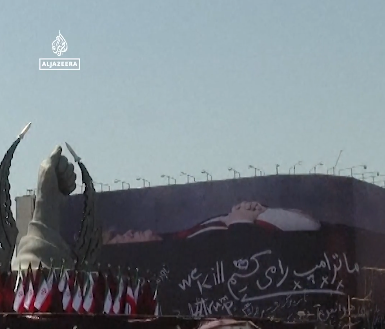
A massive billboard went up in Islamic Revolution Square in Tehran this week depicting President Donald Trump dead in a coffin, with Persian text reading "We Kill Trump." The same week — the same few days, actually — Iran quietly released Dena Karari, an American citizen wrongfully detained since December 2024.
So the propaganda department says Trump is dead. The diplomatic department says please stop bombing us.
The billboard stunt is part of a broader Iranian campaign to project strength while their military infrastructure gets systematically dismantled. As of Tuesday, the United States had conducted five consecutive days of bombardment against Iranian targets, hitting sites from Chabahar in southern Iran to the oil facilities on Kharg Island. War Secretary Pete Hegseth identified key operatives involved in planning external attacks. The Islamic Revolutionary Guard Corps, once the regime's pride, has watched its installations turn into rubble.
The numbers tell the real story. Iran has sustained an estimated $270 billion in economic damages. At least seven Iranian soldiers were killed in U.S. strikes. A naval blockade has been reimposed on Iranian ports. Trump warned in characteristically direct fashion: "You better make a deal, or you're not going to have anything left."
He wasn't done. Referencing Iran's critical oil export terminal on Kharg Island, Trump said he ordered restraint — barely. "I said hit everything but just leave that little area from 25 yards out because I don't want that in terms of the world economy," he explained. "I would do that." Translation: the only reason your oil revenue still exists is because the President decided it would inconvenience the global economy to vaporize it.
Then came the hostage release. Trump posted that "Iran has allowed an American Citizen, who was wrongfully detained in December of 2024...to leave the Country. She is now safely outside of Iran, and in good condition. The United States of America appreciates this gesture of Goodwill by Iran!" Karari's lawyer, Jared Genser, was more direct about what actually happened: "This would not have happened but for the extraordinary and relentless efforts of President Trump."
Iran's Deputy Foreign Minister insisted the U.S. is making a mistake if it thinks military attacks will force negotiations. Iranian government spokesperson Fatemeh Mohajerani echoed defiance. The regime launched Shahed kamikaze drones at U.S. bases in Kuwait and Jordan, hitting Sheikh Isa Air Base in Bahrain, Ali Al-Salem Air Base and Camp Buehring in Kuwait, and Muwaffaq Salti Air Base in Jordan. Four crew members on a Kuwait navy vessel were injured.
But here's what the defiance actually produced: a released hostage, a crumbling military footprint, and a billboard. Iran fired drones. Trump reimposed a naval blockade, disabled the Curacao-flagged oil tanker M/T Belma with Hellfire missiles to its smokestack, and promised that "next week comes the bridges." Polymarket bettors gave a U.S. invasion before 2027 only a 17% chance — not because the threat isn't real, but because the market doesn't think Iran can absorb much more before capitulating.
Ayatollah Ali Khamenei's regime tried this playbook before. They plotted assassinations against Trump, former Secretary of State Mike Pompeo, and former National Security Adviser John Bolton. The Justice Department charged individuals linked to the IRGC. Hundreds of thousands of dollars were allegedly offered in the Bolton plot alone. The regime talks about killing American leaders the way a man losing a bar fight talks about what he'd do if he really wanted to.
Iran's propaganda says Trump is in a coffin. Iran's actions — releasing hostages, absorbing $270 billion in damage, watching their ports get blockaded — say something different entirely. You don't negotiate the return of a detained American as a "goodwill gesture" when you're winning.
The billboard is still up in Islamic Revolution Square. The bombs are still falling. One of those things is going to outlast the other.