

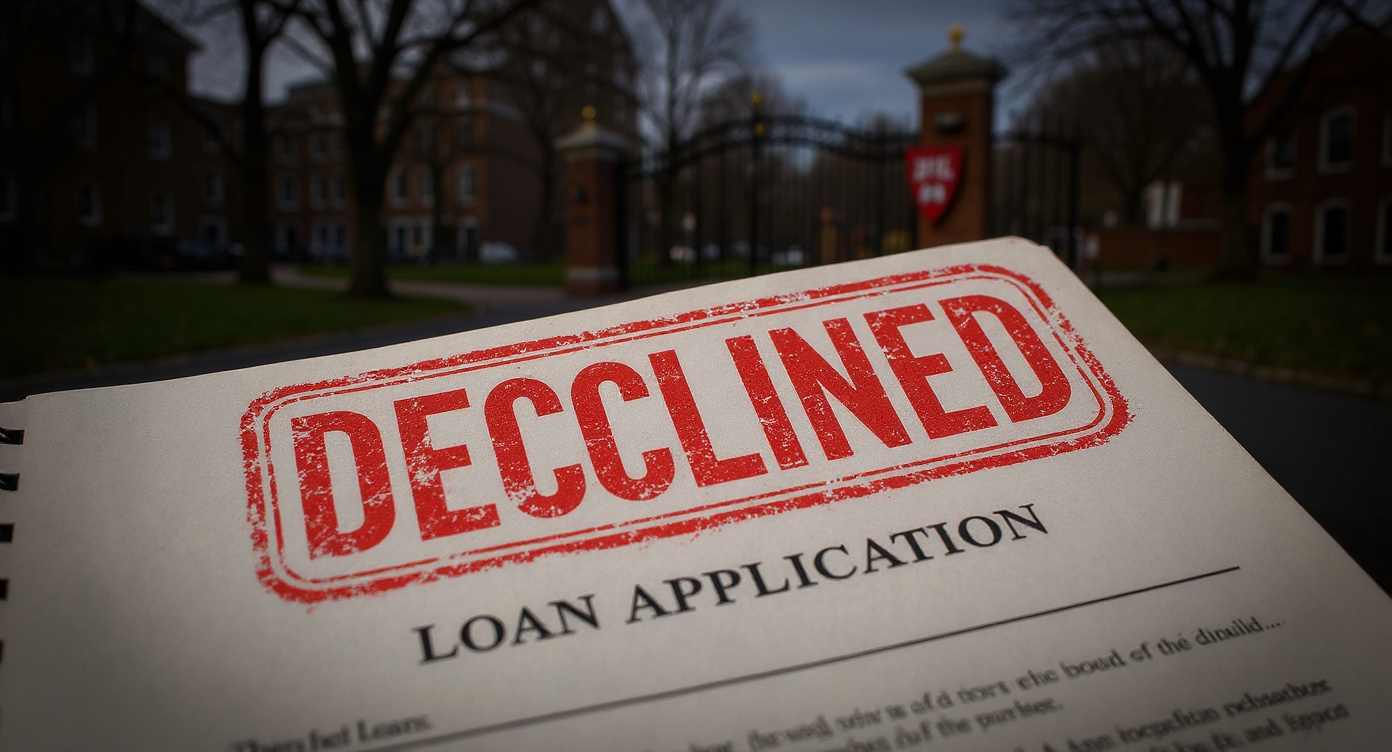
A degree from Harvard's Graduate School of Design costs about $100,000 a year to attend. The expected salary after graduation is $60,000. Private lenders will now loan those students a maximum of $15,000 per year.
Somebody finally did the math.
When the Trump administration's "One Big Beautiful Bill" eliminated GradPLUS loans in July 2025 and capped graduate student borrowing at $20,500 per year — or $50,000 for "professional" degree programs — universities were told to line up private lending alternatives. Harvard did. And what came back is the most brutal market verdict on higher education in a generation. Private lenders are now selectively refusing to finance certain Harvard degrees based on return on investment.
The numbers tell the whole story. Harvard Law School students can borrow up to $126,650 annually through the Harvard Federal Credit Union. That makes sense — Harvard law graduates earn an expected $200,000 in their first year and $500,000 annually within a decade. Lenders aren't worried about getting paid back.
Harvard Divinity School graduates, on the other hand, earn an expected $32,000 in their first year. The program carries a negative ROI of $800,000. The lenders looked at those numbers and did what any rational actor would do.
Harvard President Alan Garber acknowledged the new reality. "The federal government has greatly reduced Grad PLUS loans, and that means there's really not adequate funding for students pursuing graduate degrees anymore," Garber said. Note the framing — it's not that the degrees aren't worth the money. It's that there isn't enough "funding." As if the problem is a shortage of people willing to write blank checks.
Andrew Gillen of the Cato Institute pointed out the thing nobody in higher ed wants to admit. "Lots of people and states have criticized the Trump administration for eliminating GradPLUS," Gillen said. "But none of them have simply recreated GradPLUS loans." That's the tell. If these degrees were solid investments, states and private institutions would be tripping over themselves to fill the lending gap. They're not. Because the degrees aren't solid investments.
College Avenue, one of Harvard's preferred private lenders, now evaluates loan applications the way a bank evaluates a mortgage — based on whether the borrower can actually pay it back. Factors include credit score, expected earnings, and program ROI. Minnesota has already launched its own graduate loan program with a minimum credit score requirement of 670.
The market is making distinctions that the federal government never did. Medicine, dentistry, law, STEM — lenders will finance those all day. Design, divinity, sociology, gender studies — the money window is closing. Not because anyone passed a law banning those degrees. Because the people whose actual money is on the line looked at the earning potential and said no.
This isn't a Harvard-specific problem. It's an elite-academia problem. The UC Irvine MBA program is facing the same squeeze. For decades, the GradPLUS program let universities charge whatever they wanted because the federal government would lend students whatever they needed, regardless of whether the degree had any market value. That subsidy is gone. And without it, the emperor's wardrobe is getting a thorough appraisal.
When Harvard can't get a lender to back its own degrees, the conversation about whether college is "worth it" is over. The banks answered.