
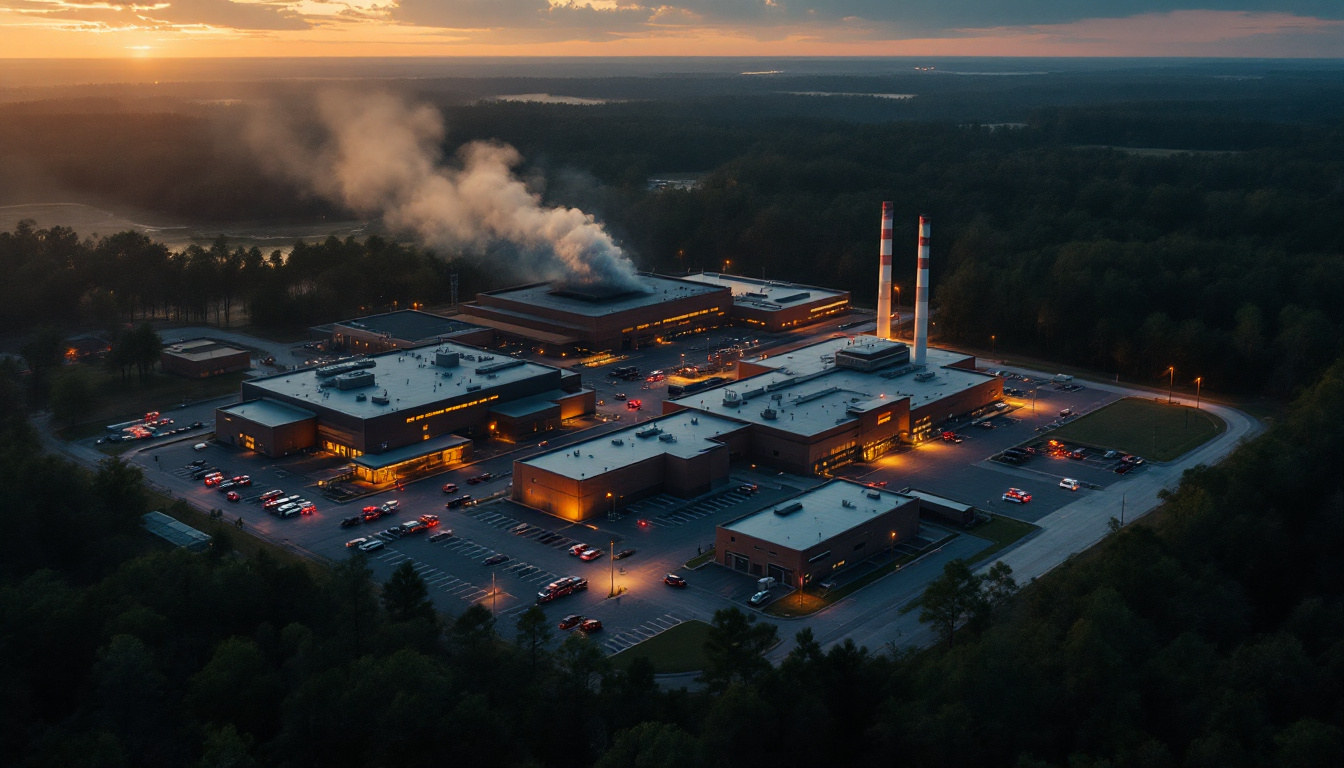
Locals have called it "the Bomb Plant" for more than 70 years. On Wednesday evening, it caught fire.
The fire broke out at the Savannah River National Laboratory, part of the Department of Energy's huge Savannah River Site near Aiken, South Carolina. At 5:39 p.m., the site declared a "Site Area Emergency." Crews put out the fire, and one employee was taken to the hospital with minor injuries.
Then came the news everyone in the area wanted to hear. "No radiological contamination has been reported," an Energy Department spokesperson said.
For a few hours, the response looked dramatic. Officials barricaded the site's entrances and restricted rail, river, and air traffic in the area. Workers who weren't part of the response were told to shelter in place. State and local agencies were notified, and nearby residents were told to follow local radio and TV for instructions.
That may sound alarming, but it's the plan working the way it's supposed to. "Site Area Emergency" is one of the Energy Department's formal emergency levels, and declaring one sets off a checklist of precautions automatically. Nobody has to make judgment calls in the middle of a crisis. Keeping traffic away and workers inside gives firefighters room to work until officials know exactly what they're dealing with.
By later that evening, the site was back to business. The barricades came down, and the workers who had been sheltering went back to their shifts. The site reported "no operational emergencies or scheduled delays."
Officials haven't said what caused the fire or which part of the lab it started in.
This isn't the first fire the lab has handled. In 2006, a flash fire during equipment cleaning burned a lab manager. In 2017, a saw cutting a sample sparked a small fire that a worker put out with a nearby extinguisher. In 2021, an exhaust fan caught fire, and the site's fire department quickly put it out. A site full of labs and heavy equipment will have small fires now and then, and the people who work there train for them.
There's a lot of history behind the gates. The site was born in the early Cold War, when Washington needed material for America's nuclear arsenal and needed it fast. The government bought out entire South Carolina towns, including Ellenton and Dunbarton, and moved thousands of residents off the land. Five reactors went up, code-named R, P, K, L, and C. For decades, they turned out tritium and plutonium for the weapons that helped keep the Soviet Union in check.
When the Cold War ended, the mission changed. Since the early 1990s, the site's main job has been cleaning up after the arms race. That means processing radioactive waste and managing nuclear materials, while still supporting the military's nuclear deterrent. The site covers about 310 square miles along the Georgia border, roughly five times the size of Washington, D.C., and the government has requested $1.785 billion to run it next year. At its Salt Waste Processing Facility, robots now do some of the work so people can keep a safe distance from the radioactive material.
Now the Bomb Plant may live up to its nickname again. On October 15, the Energy Department approved full construction of a factory on the site to make plutonium "pits," the cores of nuclear warheads. It's being built inside an unfinished plant the government started years ago and later abandoned. The goal is to turn out at least 50 pits a year in the early-to-mid 2030s. America hasn't mass-produced pits since the Rocky Flats plant in Colorado shut down in 1989.
The site also has an independent watchdog. The Defense Nuclear Facilities Safety Board keeps inspectors at Savannah River and publishes weekly reports on what happens there.
The board's next report should explain what started Wednesday's fire. Until then, the Bomb Plant is back at work.