
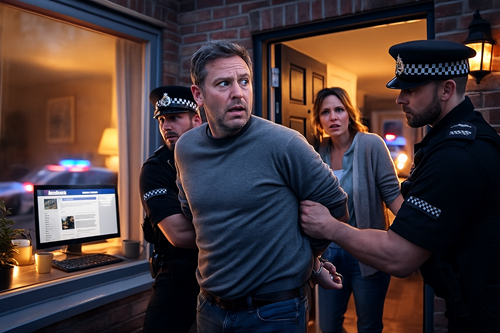
Thirty-four times a day, every single day, for five straight years, British police knocked on someone's door and arrested them. Not for robbery. Not for assault. For words.
That's not a dystopian novel. That's the United Kingdom in 2025.
A new report from Big Brother Watch reveals that 62,199 people were arrested for speech-related offenses in Britain between January 1, 2021 and December 31, 2025. The data came from 38 of 45 territorial police forces. The seven that didn't respond? Big Brother Watch estimates the real number, if all forces had reported, would be closer to 73,000. That's roughly one arrest for every 940 people in the entire country.
The crimes? Posting the wrong opinion online. Making a joke someone reported. Saying something "offensive" on social media. All prosecuted under a tidy little legal toolkit: the Malicious Communications Act of 1988, the Communications Act of 2003, and the Online Safety Act of 2023. Three laws, spanning three decades, all designed to do the same thing — make it illegal to say things the government doesn't like.
Of the 62,199 arrested, 18,520 were formally charged with communications offenses. One in five of those arrested ended up convicted.
Silkie Carlo, director of Big Brother Watch, put it plainly: "There is mounting concern among the public that speech policing is out of control in Britain." She added: "Thousands of people are being arrested for controversial speech, online jokes and non-violent protest."
Online jokes. That's a criminal category now.
The arrest rates weren't even consistent. Cumbria led the pack at 25.69 arrests per 10,000 people. Northamptonshire came in at 23.35. Meanwhile, Surrey sat at 1.70 and Staffordshire at 0.58. Whether your tweet gets you handcuffed apparently depends on your postal code.
Lord Toby Young, founder of the Free Speech Union, asked the question that should haunt every elected official on that island: "Why are the authorities spending so much time policing our tweets when they could be policing our streets?" He followed up with something even more damning: "People up and down the country daren't say what they think about a whole range of issues for fear they'll get a knock on their door."
A knock on the door. For thinking out loud.
Now here's the part where Americans should sit up. Every single legal framework Britain used to build this speech-policing apparatus — hate speech codes, online safety mandates, "harmful content" regulation — has an active champion in Washington. The same people who wanted a Disinformation Governance Board at DHS. The same crowd that pressured social media companies to silence dissenting voices during Covid. The same faction that labels parental objections at school board meetings as potential domestic terrorism.
The machinery is different. The instinct is identical.
Britain didn't wake up one morning and decide to arrest 62,000 people for speech. It happened one law at a time, one "reasonable regulation" at a time, one "we just want to keep people safe online" at a time. Each step sounded sensible in isolation. Together, they built a system where a constable can show up at your flat because a stranger reported your Facebook post.
The data represents the most comprehensive accounting of Britain's speech-policing regime ever assembled. And it landed the same week American progressives are once again floating proposals to regulate online "misinformation."
The First Amendment is the only thing standing between us and a version of that knock on the door. Sixty-two thousand arrests say it's not hypothetical anymore. It's just an ocean away.