

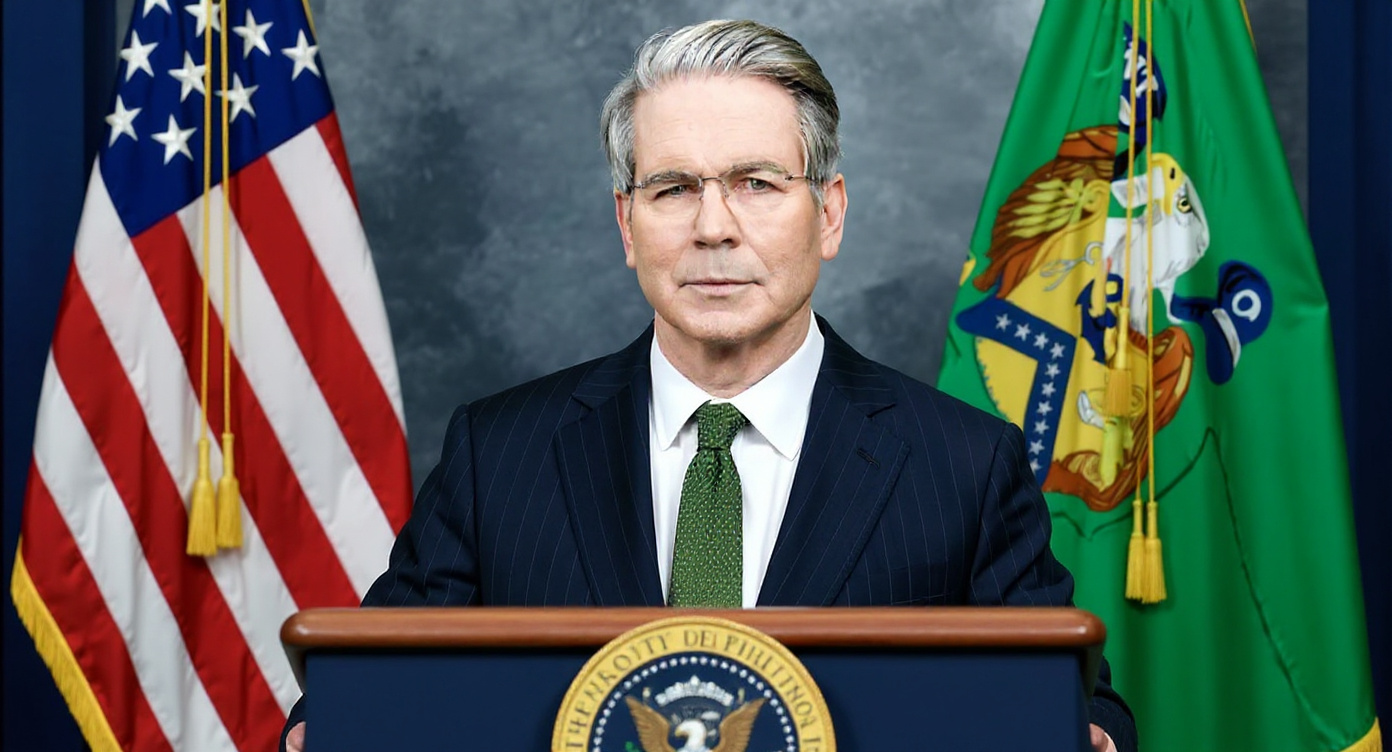
Treasury Secretary Scott Bessent went on CNBC on August 20 and said five words about Iran that no Obama-era official ever dared to whisper: "We are going to collapse this regime."
Bessent laid out what he called "the greatest coordinated economic isolation in the history of the world" — a full-spectrum financial stranglehold designed to break Tehran without firing a shot. The message to every country, bank, and shipping company still doing business with the mullahs was blunt: "You are either with us or against us."
He didn't leave much room for interpretation. "If you insist on doing business with [Iran], either transferring money, buying their oil or doing seaborne ship transfers, then the U.S. Treasury and the U.S. government ... will put its full might and force toward enforcing against you," Bessent said. Secondary sanctions — the kind that make foreign banks choose between doing business with Iran and doing business with the United States — are the centerpiece.
President Trump, never one to undersell, posted on Truth Social calling the campaign an "ECONOMIC D-DAY" and the "MOST CRUSHING ECONOMIC OPERATION EVER TAKEN AGAINST ANY COUNTRY." The all-caps were his. The substance backing them up is Bessent's.
And the military posture matches the economic one. The USS George Washington Carrier Strike Group just deployed to relieve the USS Lincoln, which had been over-extended in the region. CENTCOM is managing operations across the Strait of Hormuz, where 15-20 tankers per night still run through the southern corridor — carrying an estimated 10 million barrels per day, roughly 50% of pre-war volume. Prediction markets put the odds of Hormuz traffic returning to normal by September 30 at just 6%. The other 95% of bettors think this squeeze holds.
Bessent framed the entire approach as an alternative to kinetic warfare. "If we are doing the maximum economic pressure, then that means that likely there will not be a large-scale kinetic restart," he said. Peace through financial strangulation. Not exactly a Hallmark card, but it beats the alternative.
Tehran's response was predictable. Iranian Foreign Minister Abbas Araghchi dismissed the whole thing as a distraction from America's "unprecedented debt & surging interest costs." Iran's Deputy Foreign Minister Kazem Gharibabadi tried a different angle: "They claim Iran is on the verge of defeat, hanging by a thread, yet they are begging all their allies to help them." Iranian Parliament Speaker Mohammad Bagher Ghalibaf echoed the defiance.
That's the playbook when you're getting squeezed — pretend the squeeze isn't working while complaining about how hard it is. The "begging allies" line is particularly rich coming from a regime that relies on China and Russia to keep its economy on life support.
Compare this to 2015. The Obama administration's idea of maximum pressure was flying $400 million in cash on pallets to Tehran in the middle of the night and calling it a diplomatic breakthrough. The JCPOA gave Iran a path to a nuclear weapon on a timeline, sanctions relief worth billions, and a photo op. What it didn't give anyone was peace.
Now the approach is reversed. No secret side deals. No unmarked cargo planes. Just a Treasury Secretary on national television saying the quiet part out loud — the goal is regime collapse through economic force — and a carrier strike group parked in the neighborhood to make sure everybody heard him.
Qatar's Foreign Minister Sheikh Mohammed bin Abdulrahman bin Jassim Al Thani said publicly that "we need the situation to go back to what it used to be before." That's the sound of a regional power adjusting to the new math.
The old math was appeasement dressed up as diplomacy. The new math is a financial chokehold with a carrier group standing behind it.