

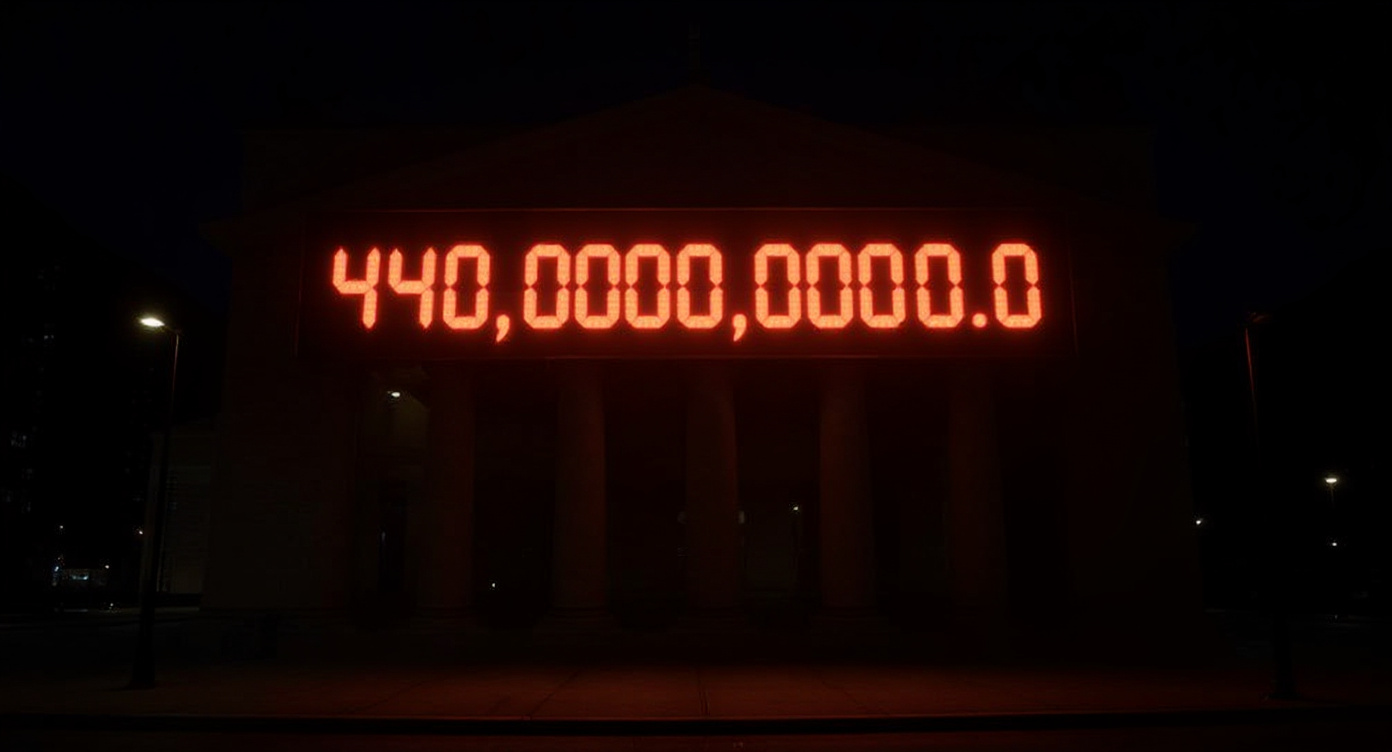
It took the United States 200 years to accumulate its first $1 trillion in debt. It took 95 days to add the last one.
The U.S. national debt crossed $40 trillion on August 19, 2026. Treasury Secretary Scott Bessent's department confirmed the milestone after a single-day jump of $60 billion pushed the counter past the threshold. Five years ago, in January 2022, the debt hit $30 trillion. One-third of the entire national debt has been stacked on in less than half a decade.
That's not a typo. That's not an exaggeration. That's the Treasury Department's own math.
The numbers underneath are worse than the headline. Interest costs through June 2026 have already hit $1.37 trillion — a 20% increase over the same period last year. The government's most recent semi-annual coupon payment clocked in at $85 billion, the largest on record, up from $75 billion in August 2025 and $80 billion in February. Interest on the debt is now the third-largest line item in the federal budget, having surpassed healthcare spending. Only Social Security, at $1.6 trillion annually, and defense sit above it.
We're paying more to service old borrowing than we spend keeping people alive.
Douglas Holtz-Eakin, president of the American Action Forum and a former director of the Congressional Budget Office, called the federal budget "the enemy within" and "the greatest threat to economic progress and national security." Matthew Luzzetti, chief U.S. economist at Deutsche Bank, offered a more diplomatic read: "Optically, I'm sure crossing thresholds like $40 trillion will focus attention on the issue in the near term."
That's Wall Street for "everyone will talk about it for a day and then go back to spending."
Michael Peterson, chair of the Peter G. Peterson Foundation, said he hoped "hitting this big round number will hopefully send a wake up call throughout Washington." Washington has been hitting the snooze button on that alarm since the Clinton administration.
Bessent has publicly committed to reducing the deficit-to-GDP ratio to 3% by January 2029 — the end of Trump's second term. The current ratio sits at 6%.
Fitch reaffirmed the U.S. credit rating at AA+ just last week, which sounds reassuring until you remember that AA+ is itself a downgrade from the AAA rating the country held for decades. The 30-year bond auction yielded the costliest sale in 25 years. The 10-year drew the highest financing cost since 2007. Investors aren't panicking — they're just quietly charging us more to borrow.
Remember DOGE? Elon Musk's Department of Government Efficiency was supposed to take a chainsaw to federal spending. The projected cuts didn't materialize. The debt ceiling sits at $41.1 trillion, which means at this pace we'll smack into it again in four to five months and get another round of congressional theatrics where both sides pretend to care about fiscal responsibility while voting to raise the limit.
We're essentially in a doom loop. We borrow to pay interest on what we already borrowed. The interest gets more expensive. So we borrow more. The loop tightens.
Both parties built this. Republicans cut taxes without cutting spending. Democrats increased spending without increasing revenue. The result is bipartisan in the truest sense: everyone contributed, nobody's fixing it, and the bill goes to the same people it always does.
Ninety-five days for a trillion dollars. That's faster than most people pay off a used car.